
The Foodlands Cooperative of BC recently received a New Horizons for Seniors grant for our Aging in Place project. With this project we examined challenges that may limit the ability of Community Farm members to age in place and stay in their communities.
Aging in Place Discussion Kit
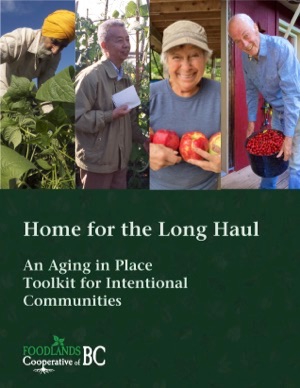
This 6 part discussion guide is available for download in PDF format
The primary goal of the initiative is to build capacity for healthy aging on Community Farms by increasing knowledge, developing practical tools, and expanding viable housing and lifestyle options. There are few templates and organizational structures that are well suited to this task. We gathered information and wisdom from existing Community farms and built tools to help groups that are just beginning their journey. To that end we developed the Aging in Place Discussion Guide. It is available with a free download.
Throughout the project we explored issues of housing affordability, housing policy, and stability as it pertains to seniors living on Community Farms through in-person gatherings, Zoom meetings with member farms, one-on-one conversations, and surveys to gain insight on these issues and seek best practices and common ground. This process provided fertile ground for discussion around other issues including succession planning, governance, community building, and conflict resolution, all of which affect the health and well being of the community.
We are in the initial stages of forming discussion groups and guilds both for our members and the interested public to further explore and enhance the understanding of these issues, and seek cooperative and collective solutions.
We found through previous work that Community Farms generally do not have formal or uniform housing policies that would balance the need to have new community members and the desire to keep aging members as part of their community. Unclear or inconsistent housing policies and unresolved interpersonal conflict often lead to difficult conversations and uncomfortable decisions.
A common physical barrier for aging members to stay in place is housing. Building new housing for incoming members and workers is expensive, has long timelines, and in many cases is prohibited by restrictive municipal zoning and ALR regulations. Similarly, housing modifications can be expensive, face zoning and inspection issues, have negative impacts on other members, and in some cases may not be practical.
By examining pathways for seniors to “age in place,” the project aims to honour their dedication, promote their physical and mental well-being, and preserve their invaluable agricultural wisdom to mentor the next generation of young farmers.


